


Sock Sewing Machine
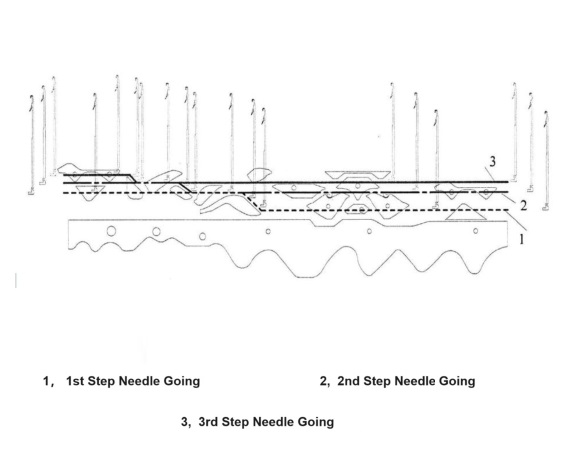
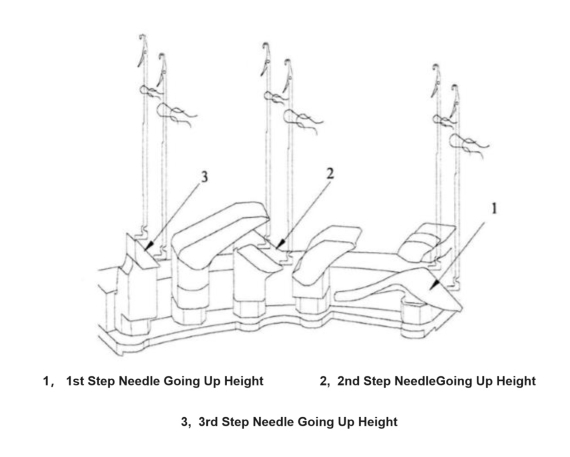
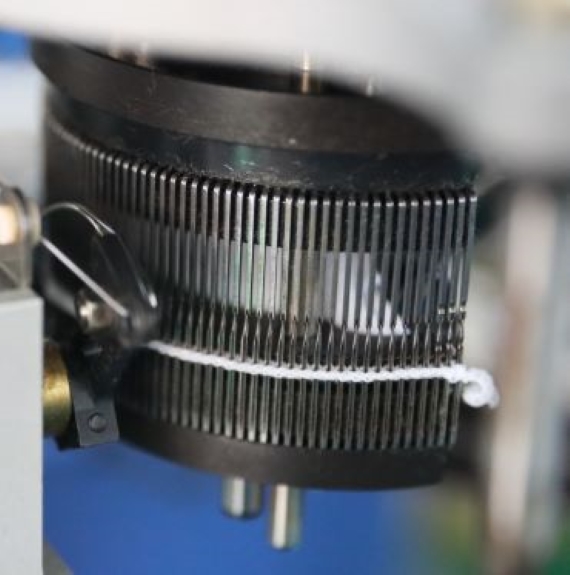
Within the automatic sock sewing machine, firstly move the lower stitch loop to the sewing teeth of the sewing plate, flip the knitted socks into the sock moving tube, and then move them to the sewing position through the sock moving mechanism to sew the sock toe. This process is called sock moving. After the last section of the sock is knitted, the machine head rises and the transfer plate starts to work. The stepper motor is driven into the knitting area and the inner transfer plate is aligned with the axis of the needle cylinder. All yarn feeders are out of work, the first looping triple focus is entered in stages, and the needle press cam, elastic needle press cam, and yarn bending cam are out of work. As the needle cylinder rotates, the knitting needle rises to the first height along the back of the first looping triangle; when the needle cylinder rotates to the next rotation, the first looping triangle is driven in step by step, and the knitting needle rises along its back to the second height; Finally, the sock heel triangle is driven in stages, and the knitting needle rises to the loop transfer height. The figures show the different height positions of the knitting needle and the knitting needle trajectory during the knitting process.
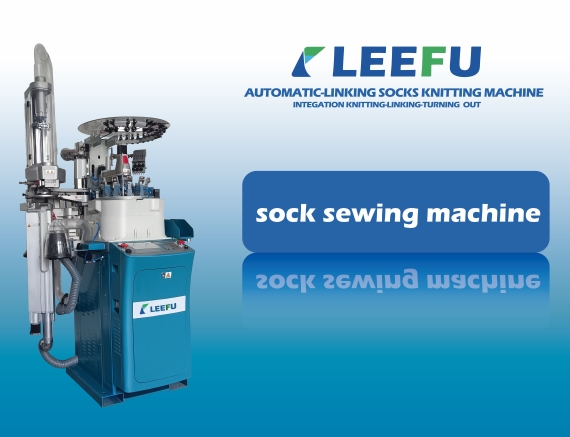
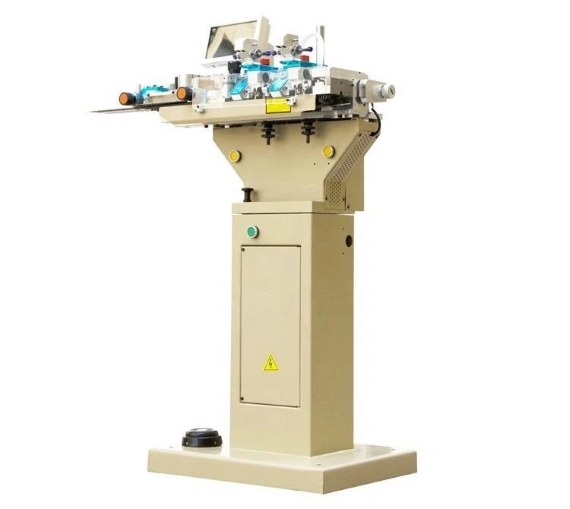
Automatic Sock Sewing Machine

Transferring Sock
After the automatic sock sewing machine head rises, the airflow pulling system blows up the toe of the sock by blowing air, and the coil is in a relaxed state. Under the action of the triangle, the knitting needle rises along its back to the height of the transfer coil, as shown in the picture of the transfer plate cooperating with the syringe and the positioning rod matches the syringe hole-to-hole to control the positioning of the transfer plate.
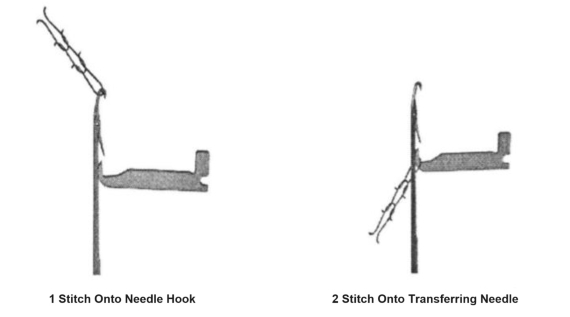
After the transfer plate of the automatic sock sewing machine drops to a certain height, the transfer plate separates, the upper transfer plate rises, and the lower transfer plate continues to fall. When it passes the syringe sensing point, the lower transfer plate stops falling. At this time, the signal rod pushes the positioning hole to rotate inward and drives the inner disk to rotate by transferring the lower disk groove. Since the groove of the transfer tooth is covered with an elastic ring, the interior of the dial shrinks. Driven by the elastic force of the rubber band, the transfer tooth also Follows the inward contraction, the transfer tooth groove is located 1mm below the knitting needle, and the coil is located at the needle hook as shown in the figure.
The Transferring Stitch of Sock Sewing Machine
Through the suction mode of the airflow pulling system of the sock sewing machine, the sock is in a tight state and moves downward along the needle cylinder, and the coil is simultaneously hooked by the hook needle of the lower transfer plate; the upper transfer plate descends, using its weight and moving the upper gear to all the loops are transferred to the hook needle, and the loop is transferred from the knitting needle to the transfer plate hook needle, as shown in the picture. After the loops are transferred from the knitting needles to the transfer plate inside the needle cylinder, the transfer plate rises, and the knitting needles descend to the knitting height under the action of the needle cam to re-knit. The transfer plate rotates to the seam head area driven by the stepper motor. When the transfer plate rotates to the seam head needle plate sensor, the upper transfer plate stops moving, and the lower transfer plate continues to rotate until it is aligned with the axis of the sock-turning tube. The sock-turning system and the device tilts downward, and the airflow-pulling system sucks the knitted socks under the sock-turning device in a suction manner, completing the first transfer of the coils from the knitting needles to the transfer plate.
Sock Sewing Machine Step1
The sewing step is the last process in the sock knitting process of the integrated sock machine (automatic sock sewing machine). The sock blank must pass through the sewing before it can become a sock. Originally this process was performed on a sewing machine, but now it can be automatically sewn on a sock machine. However, the quality of the sock toe stitching directly affects the appearance and quality of the socks, so this process is also one of the important processes in the sock knitting process. The requirement for the sock toe stitching is that it must be elastic enough to prevent the garment from breaking due to the tightening of the sutures. It also needs to be soft so that it is comfortable to wear without affecting its appearance. The elastic sock sewing has the above advantages. Therefore, double-thread elastic seams are commonly used on socks. This kind of elastic sewing is also used on the integrated sock machine. This kind of elastic sewing sock is formed by the sewing loops formed by the upper thread and the lower thread passing through each other.
Sock Sewing Machine Step2
During the second stitch transfer process of the automatic sock sewing machine, the tight cooperation of the sock turning system, the transfer bottom plate, and the suture system are required. The stitching of the sock toe is mainly divided into the transfer of the stitch from the transfer plate to the sock turning mechanism, and the transfer of the stitch from the sock turning mechanism to the stitch head mechanism, and then the stitching of the sock toe is completed by a sewing machine. Move the lower plate to align with the axis of the inner tube of the sock-turning device, and the socks have been sucked into the inner tube. When the socks are sucked into the inner tube of the sock-turning device, the signal rod of the transfer plate moves outward, and then the transfer plate drives the groove to expand outward. The screw on the middle ring of the lower plate drives the ring to move outward, and then the transfer teeth move outward. shrink. The transfer lower plate continues to rise, and the suture needle plate positioning rod enters the transfer plate hole. When it drops to the specified height, the transfer lower plate stops rising. The signal rod retracts and the transfer disk signal rod rotates, moving the transfer hook needle radially toward the transfer disk needle cylinder.


Sock Sewing Machine Step3
The sock-turning tube of the automatic sock sewing machine rises, the sock is turned over, and the sock-turning tube is fixed in the sock’s holder on the sewing head needle cylinder. The sock-turning device rises and transfers the coil from the transfer tooth to the suture needle through the sock-turning teeth, realizing the second transfer of the coil, that is, the transfer of the transfer plate to the suture needle. At this time, all the coils are transferred to the suture needle, and the suture needle and the disc flips the outer half of the stitch barb 1800 through the intermediate shaft to connect it to the upper half of the stitch barb one-to-one, and uses the sock pressing disc of the sewing needle disc to press the sock toe coil to make final preparations for the stitch head. The needles of the sewing machine are partially driven in. One of the needles is inserted into the coil and aligned with the stitch barb. The sewing machine starts to automatically sew the sock toe. The stitch head stitches are sewn with hemming chain stitches, its sewing principle is similar to that of an ordinary sewing machine. The two sewing needles in the sewing machine are used to sew alternately until the stitch is completed. The scissors of the sewing machine come into work, cut the thread ends, suck the socks into the bell mouth through the suction system, and complete the knitting of socks.