

Knitting Toe And Heel of Socks
The heel of the sock should be knitted into a bag shape and its size should be suitable for the person’s heel. Otherwise, wrinkles will form on the back of the sock when the sock is worn. When starting to knit the sock heel, a part of the sock knitting needles corresponding to the knitted sock top stops working. The sock needle cylinder rotates back and forth, and the sock knitting needles for knitting sock heels first narrow the needles in a certain order, and then release the sock knitting needles when a certain number of sock knitting needles is reached, as shown in Figure. When the sock heel is knitted, the sock knitting needles that have stopped working start to work again. There is a heel seam in the middle of the bag-shaped sock heel. The structure of the heel seam affects the quality of the finished product. The formation of the heel seam depends on the way the sock knitting needle is retracted and released. There are two types of heel seams: single heel seam and compound heel seam.
TWO TYPES OF HEEL SEAMS: SINGLE HEEL SEAM AND COMPOUND HEEL SEAM
If the sock knitting needle barrel rotates once to close one sock knitting needle during the sock knitting needle narrowing stage, and the sock knitting needle barrel rotates once during the sock knitting needle releasing stage to release one sock knitting needle, a single heel seam will be formed. In the single heel seam, the double thread loop is removed from the single thread loop. The fastness of the sock heel is poor and is generally rarely used.
If the sock knitting needle barrel rotates once to close one sock knitting needle during the sock knitting needle narrowing stage, and rotates once during the sock knitting needle releasing stage to release two sock knitting needles and close one sock knitting needle, a compound heel seam will be formed. The compound heel seam is made up of two rows of double-thread loops connected. The holes formed by the heel seam at the seam are smaller and the seam is relatively strong, so it is widely used in the production of round socks.
The structure and knitting method of the sock toe is similar to that of the sock heel. Generally, a reinforcement circle is knitted before knitting the sock toe, and after the sock toe is knitted, the eyelet rows and the holding rows are knitted. The purpose is to make it easier to sew the sock toe later and to improve the quality of the socks.
Knitting Toe And Heel of Socks
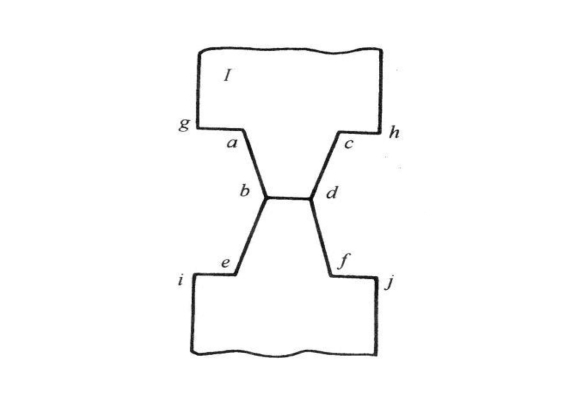
Knitting Heel of Socks
The figure shows the unfolded view of the sock heel. Connect ab and cd to the corresponding parts be and df respectively. Connect ga to ie, ch to fj to obtain a bag-shaped sock heel. When starting to knit the sock heel, the sock knitting needles forming the ga and ch sections should be stopped. The number of sock knitting needles is equal to half of the total number of needles in the sock needle cylinder, and the other half of the sock knitting needles forming the ac section should be stopped during the knitting process of the first half of the sock heel. Carry out single sock knitting needle narrowing until the number of working needles in the sock needle cylinder is only 1/6 to 1/5 of the total number of needles, thus forming the first half of the sock heel as shown in figure a-b-d-c. The second half of the sock heel is knitted starting from the bd section. At this time, the method of placing two needles and closing one needle is used to gradually increase the number of working stitches, so as to obtain the second half of the sock heel consisting of b-d-f-e sections as shown in the picture.
THE METHOD TO REMOVE THE SOCK KNITTING NEEDLES - USING THE SOCK HEEL TRIANGLE
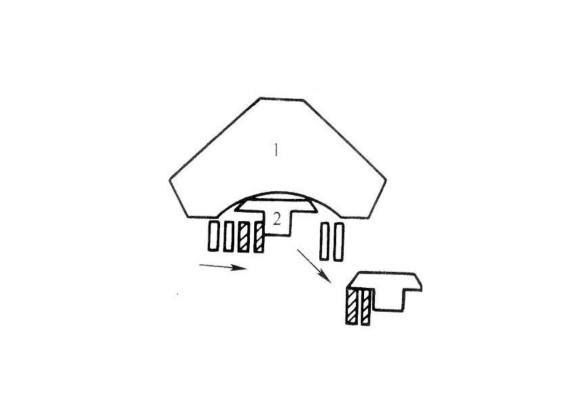
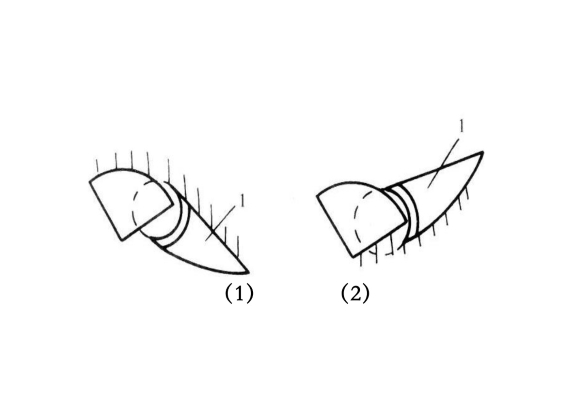
This method is also commonly known as the sheep’s horn. At this time, with the keyway of the sock needle cylinder as the center, insert short heel sock needles on half of the keyway sock needle cylinder to knit the sock bottom, and insert long heel sock knitting needles on the other half of the sock needle cylinder to knit the sock top. Before starting to knit the sock heel, turn the sock heel triangle l downward (Figure 1) and leave it at a certain distance from the sock needle cylinder. The short heel sock knitting needle cannot be touched, but the long heel sock knitting needle (sock top needle) on the needle cylinder is raised. Go above the upper middle triangle 2 and exit the knitting area. The short heel sock needle remains in its original position and participates in the knitting of the sock heel section. When the sock heel knitting is completed, the sock heel triangle 1 rotates upward (Figure 2) and is close to the sock needle cylinder, which can act on the heels of all sock knitting needles, so that all sock knitting needles that have withdrawn from work can enter work.
THE METHOD OF MAKING THE SOCK KNITTING NEEDLES WITHDRAW- THE BURIED STITCH METHOD
Buried sock knitting needle movement means that the sock knitting needles on the knitted sock surface do not rise, but are buried in the triangular base and rotate back and forth without placing sock yarn in a loop. The advantage of this knitting method is that it eliminates the space occupied by the sock heel triangle, because the sock knitting needle does not need to be raised, thus preventing an oil mark on the sock surface.
The sock knitting needles on the sock needle cylinder are arranged as follows: insert middle heel needles on the half-cylinder with a keyway to knit the sock bottom; insert extra short heel needles on the other half of the sock needle cylinder to knit the sock top. When starting to knit the sock heel, the left and right bending triangles, and the left and right movable panels are all a certain distance away from the sock needle cylinder. Therefore, these triangles and panels can only act on the middle heel sock knitting needle and cannot touch the extra short heel needle. Knitting the sock top. The extra short heel needle runs back and forth in the triangular base without laying sock yarn to form a loop.
THE FIRST HALF OF THE SOCK HEEL (SOCK TOE) OF 1ST PROCESS
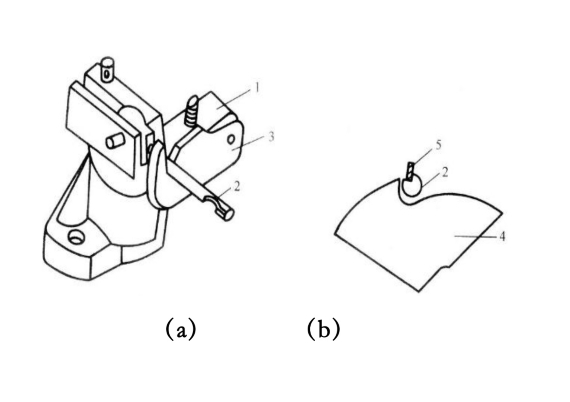
When knitting the first half of the sock heel (sock toe), the sock knitting needle is narrowed by picking up one stitch on each side of the sock knitting needle during each reciprocal rotation of the sock needle cylinder to stop knitting until the specified number of sock knitting needles are picked. Sock knitting needle picking is completed by a needle picking device. Behind the left (right) bending sock yarn triangle of the sock knitting needle cam seat, there are left (right) needle picking racks l respectively installed, as shown in Figure A. There is a notch at the head end of the left (right) needle-picking lever 2, and the depth of the notch can just accommodate a needle butt. The left and right needle-picking levers are connected by pull plates. When knitting sock heels, the sock needle cylinder reciprocates, because the head end of the left needle-picking rod 2 is in the upper notch of the left sock yarn bending triangle 4, as shown in Figure B.
THE FIRST HALF OF THE SOCK HEEL (SOCK TOE) OF 2ND PROCESS
Therefore, the first short heel sock knitting needle with the sock needle cylinder turned upside down enters the notch at the head end of the sock knitting needle picking bar. Under the push of the sock knitting needle heel 5, the head end of the left sock knitting needle picking bar 2 is forced to rise along the slope of the guide plate 3 upward in the direction of the back of the triangle, raise this sock knitting needle to the back of the upper middle triangle, exiting the knitting area. While the left needle-picking lever is picking the sock knitting needle, use the pull plate to make the right needle-picking lever enter the notch on the back of the right bending yarn triangle (when knitting the sock tube and leg, the head end of the right needle-picking lever is not in the back of the right bending yarn triangle) (in the notch) to prepare for the picking of the first short heel sock knitting needle that will be turned forward next time. Pick the sock knitting needles alternately in this way to form the first half of the sock heel knitting.
THE SECOND HALF OF THE SOCK HEEL (SOCK TOE)
When knitting the second half of the sock heel (sock toe), the sock knitting needles that have stopped working must gradually rejoin the knitting. For this purpose, a sock knitting needle press is used, as shown in Figure. It is arranged opposite the yarn guide seat, and is equipped with a needle pressing bar. The head end of the needle pressing bar is in a “T” shape, and the width of the gaps on both sides can only accommodate two sock knitting needle butts. When knitting the first half of the sock heel, stocking tube, or sock foot, the sock knitting needle press stops working. At this time, the sock knitting needle passes between the lower plane of the foot caltrop 1 and the upper plane of the press needle head 2. When the sock knitting pressing device is working, its head end is located in the concave position of the center of the footed water chestnut 1, just in time on the stroke line of lifting the sock needle. When releasing the needle, when the raised sock heel needle moves to the footed corner 1, the first two sock knitting needles will enter the gap of the sock knitting needle pressing head 2, forcing the sock knitting needle pressing rod to descend along the arc-shaped action surface of the sock knitting needle pressing guide plate. Press two sock knitting needles at the same time to the same height as the back of the left or right curved yarn triangle to join in knitting. When the sock needle cylinder rotates to a certain angle, the sock knitting needle is separated from the needle pressing rod, and the sock knitting needle pressing rod is reset by the action of the spring, ready to press the sock knitting needle when it rotates in the other direction. During the needle-releasing stage, the sock knitting needle picker still participates in the work, so that every time the syringe rotates, two sock knitting needles are pressed to select one sock knitting needle, that is, every time the syringe reciprocates, one sock knitting needle is placed on each side.