



Sock Knitting Pattern
According to the forming structure of the sock toe, the sock knitting pattern design can be divided into three types of fully formed socks: ordinary closed-toe socks, five-toe socks, and inner five-toe socks. The knitting technology of each section of fully formed socks is studied separately, especially the three types.
The sock toe uses a local knitting process to achieve arc-shaped and inner five-finger toe spacer knitting. During the knitting process of sock legs and sock tubes, the transverse size changes of the sock cylinder are achieved through the needle retracting and releasing process. The sock heel is knitted back and the needles are retracted at the same time to form a trapezoidal bag-like structure. The sock openings are ribbed and elastic yarn is inserted to prevent them from sliding down during wear, and a flat closing process is used for the final processing of the sock openings.
Sock Knitting Pattern Classification
The structure of the toe sock knitting patterns mainly includes sock toe, sock top, sock sole, sock heel, sock tube, and sock opening. The sock toe is usually similar to an arc shape and can be knitted in an arc shape through a local knitting process. The sock foot is composed of a sock top and a sock sole. The length of the sock foot determines the size of the sock, that is, the sock size. When knitting the sock heel, a local knitting process is used to form a bulge to adapt to the shape of the heel. Socks are mostly made of plain stitch or rib knitting, and the appearance can be improved through intarsia or jacquard knitting. The function of the sock opening is to make the hem of the sock close to the leg, making it easy to put on and take off, and prevent it from falling apart or sliding down.
According to the structure of the sock toe, socks can be divided into ordinary toe socks, five-toe socks, and inner five-toe socks. Ordinary covered-toe socks are more common, with five-toe covered together, and the knitting process is relatively simple. Each toe of five-toe socks is knitted separately, which not only meets the needs of thermal insulation and comfort but also has health care functions. Although five-toe socks look like ordinary toe socks on the outside, each toe inside is spaced apart and must be adjusted at an appropriate ratio. The width of the five-toe sock and the height of the toes must be smaller than the height of the smallest toe. width
Fully Formed Socks Knitting Principle
Ordinary Toe Sock Knitting Pattern
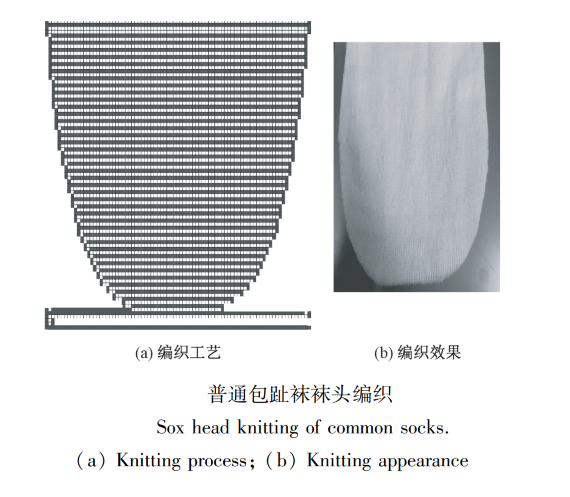
Use the full-needle knitting method and knit ordinary toe socks in the normal direction. The sock head uses 2 yarn feeders for cylinder knitting, 1 main yarn, and 1 spandex yarn. The sock-toe knitting process diagram is shown in the figure. Before knitting starts, the scissors of the yarn insertion device cut the yarn, use its clip to clamp the yarn, and follow the stacked yarn mouth to the left end of the needle bed. Needle rib weave to achieve sock toe closure, first perform full needle cylinder knitting and then use a partial knitting process where both sides are paused in the middle to knit. Only a few needles are reserved in the middle for knitting, and all knitting needles on both sides are paused for knitting, and then used according to the rules The method of gradually adding needles to the left and right to introduce back knitting is to bring the previously rested knitting needles back into knitting until all the resting knitting needles resume knitting, and finally form an arc-shaped sock toe. After the sock toe is knitted, the yarn insertion device clamp located at the left end of the needle bed moves to the right and the thread end of the knitting start is inserted into the inside of the fabric. The picture shows the corresponding knitting renderings.
Ordinary Five Toe Sock Knitting Pattern
According to the different connection methods of toe and crotch, the Five Toe Sock Knitting Pattern can be divided into ordinary and three-dimensional crotch. The knitting direction can only start from the sock toe, and the reverse direction is not supported. The ordinary crotch realizes the connection between the toes through overlapping mesh, while the three-dimensional crotch realizes the connection through three-dimensional cornering. The five toes of the sock are all knitted using local knitting technology. The knitting order is the big toe, second toe, third toe, second little toe, fourth toe, and little toe.
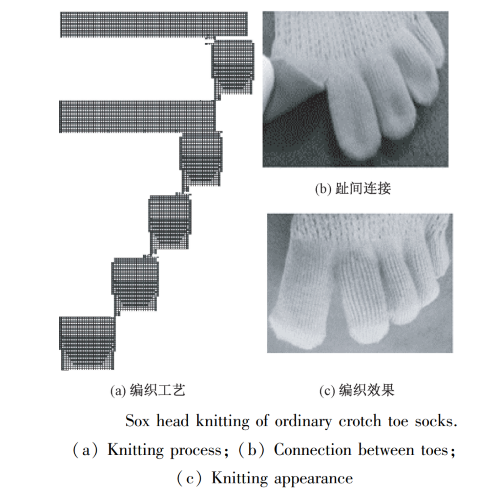
When the ordinary hip knitting, the knitting process diagram is shown in the figure. the five toe knitting from the bottom of the big toe use Siping tissue to achieve a closed toe tip, uses a local knitting process to achieve an arc-shaped knitting of the toe tip, and then performs cylindrical knitting with a constant width. After the big toe knitting is completed, the other toes are knitted in sequence, the knitting method is the same but the lengths vary. After the knitting of the second toe is completed, the second toe is moved toward the big toe and overlapped through movements such as needle transfer and movement of the rear needle bed to realize the connection between the toes. The connection effect is shown in the figure. Generally, the number of overlapping meshes should not be too many, otherwise the entrance will be too narrow. When knitting with full needles, 3 needles are usually used, and when knitting with alternate needles, 2 needles are used. After completing the knitting of the third toe and the sub-little toe, bring the previously rested knitting needles back into knitting, knit the four-toe palm area, and finally knit the little toe. The picture below shows the corresponding knitting renderings of the five-toe sock knitting pattern.
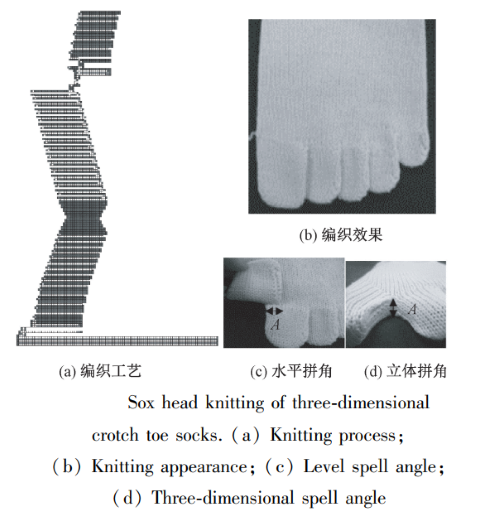
Five Toe Sock Knitting Pattern of Three-dimensional
A three-dimensional crotch of five toes can only be realized when knitting with full needles. The knitting time is longer than that of ordinary crotch, and jacquard and stripe patterns cannot be drawn on the toe part. The knitting order of the 5 toes is the same as that of ordinary crotch, the difference lies in the knitting method of the toes and the connection method between the toes.
The Sox Head Five-Toe Sock Knitting Pattern starts from the base of the toe of the sock sole. The knitting process is as shown in the picture. The bottom knitting is a four-flat knitting, and then the yarn feeder knits one row on each of the front and rear needle beds, and then only knits on the front needle bed. The connection between the toe sock sole and the sock surface, the knitting process of the sock sole is continuous at both ends. Perform 1 stitch in the front tuck when knitting in, 1 stitch in the back tuck in the front bed when knitting out, and move the needle to the right: Continuously perform 1 stitch in the sock knitting process at both ends of the knitting process without knitting, and change the previous stitch. Turn the needle forward one stitch at a time and move the needle to the left to form a closed tube shape at the lower end. Follow the above method to complete the knitting of other toes in sequence, and connect the toes through angles. Because each toe is spliced by cutting yarns, threads will appear on the toe tips and crotch areas. The yarn insertion device can directly insert the threads into the inside of the fabric, reducing the thread-handling process. The picture shows the corresponding knitting rendering. Because the finger crotch is a three-dimensional corner, it is easy to wear. The width of corner A can be changed through the crotch setting. The number of corner stitches is mostly set to 4 stitches. If the number of corner stitches is too much, it will not only narrow the entrance but also increase the height or thickness of the corners. The pictures are respectively the appearance renderings of the corners in horizontal and five-toe sock patterns of three-dimensional states.
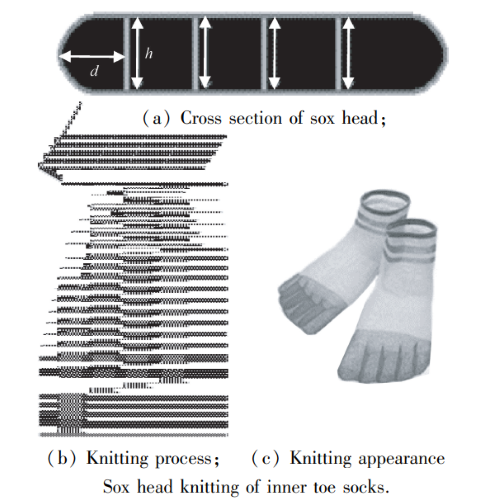
Sox Head Knitting of Inner Five Toe Sock Knitting Pattern
Each inner five-toe sock knitting pattern is separated by a spacer inside the sock. To achieve spacer knitting, as shown in the figure, the height h of the spacer must be smaller than the width d of the little toe. Due to the special structure of the five-toe socks, they must be knitted with alternate stitches and the knitting direction is from the sock opening to the sock toe.
The knitting process diagram is shown in the figure. The bottom is divided into waste yarn knitting, and the weft plain needle structure is used for cylinder knitting. After the set number of rows of waste yarn knitting process is knitted, the drawn yarn is knitted. The number of drawn yarn procedures is mostly 2 rows. After completing the waste yarn and drawing yarn knitting, we start knitting the sock opening, sock tube, sock heel, sock toe, and other parts. When knitting to the toe of the sock, while knitting the sole and top of the foot, use a local knitting process to perform local multi-knitting in the little toe space to knit the toe spacer pieces of the little toe and sub-little toe. Follow this method to complete other spacers. Piece knitting. After the sock toe is knitted, return knitting is first performed on the sock bottom, which is the rear needle bed, and then the sock toe is sewn through the flat closing process. The flat closing processing type can be selected to focus on efficient knitting to reduce the number of defective products, and finally, flat closing is formed. The suture line is on the side of the foot. The picture below shows the corresponding knitting effect.
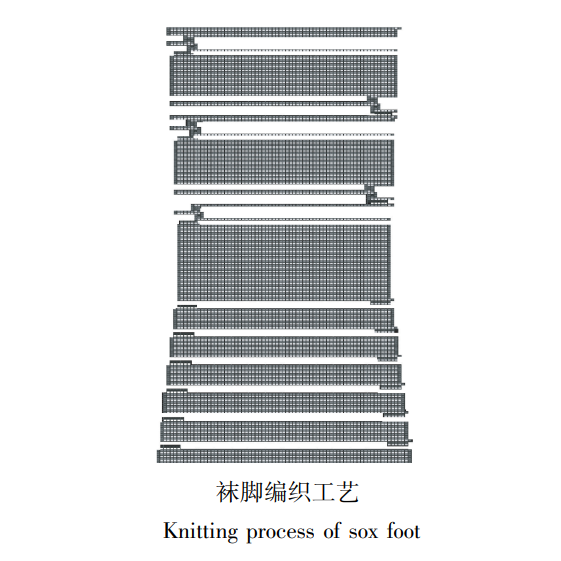
Knitting Process of Five Toe Sock Foot
The five-toe sock foot section is cylindrically knitted, and the width of the sock foot is changed during the knitting process, with the action of retracting and releasing the needle. The sock knitting pattern process diagram is shown in the figure. First, use the concealed narrowing method to perform cylindrical knitting with gradually decreasing width on the front and rear needle beds. When knitting to the sole, keep the knitting width unchanged, and then use the concealed needle method to make the knitting. The width of the weave gradually increases to adapt to the structure of the human foot. Usually, the needle reduction range for the big toe side and the little toe side is 1~1.5 cm, and the needle increase range is 0.5~1.0 cm.
Sock Heel Knitting Process
The heel of the sock needs to be knitted into a bag shape, usually using a flat stitch and needs to be reinforced to increase knit resistance. As shown in the picture, there are two styles of sock heels: ordinary sock heels and right-angled sock heels. In comparison, the latter has higher stability, is less likely to slip, and is more comfortable to knit. Studies have shown that Asians generally have smaller feet and a smaller heel arc. According to ergonomic principles, right-angle socks are more in line with Asian feet.
The sock knitting pattern process diagram is shown in the figure. Ordinary sock heels adopt the principle of local knitting, so that the knitting needles on the front needle bed are suspended from knitting, and only the return knitting is performed on the rear needle bed. At the same time, the needles are retracted and released as required to form a trapezoidal bag-like structure. When knitting a right-angle sock heel, you need to carry out return knitting on the front and rear needle beds at the same time to form a right-angle shape. The larger the return amount of the front needle bed, the more standard the right angle formed by the sock heel, which can avoid unnecessary fabric pieces at the ankle. phenomenon to increase its sense of fit. Generally, the needle reduction amount of the sock heel should not be set too large, otherwise it will increase the difficulty of knitting. It is generally set at about 2.6 cm.
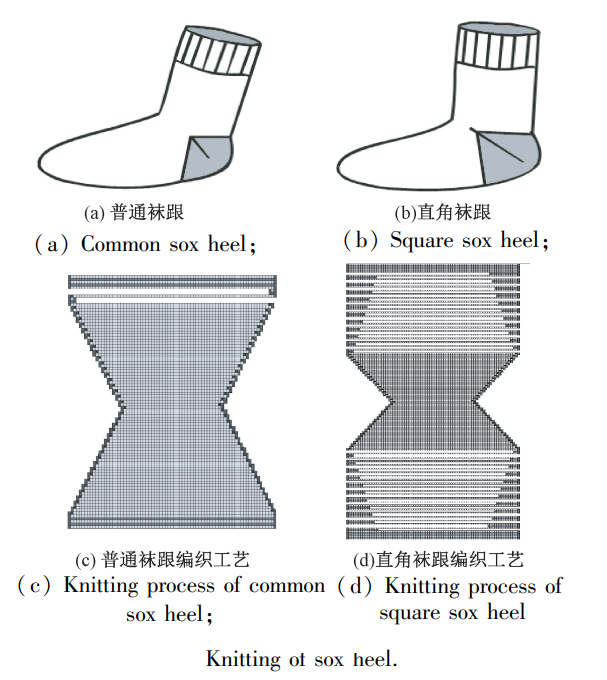
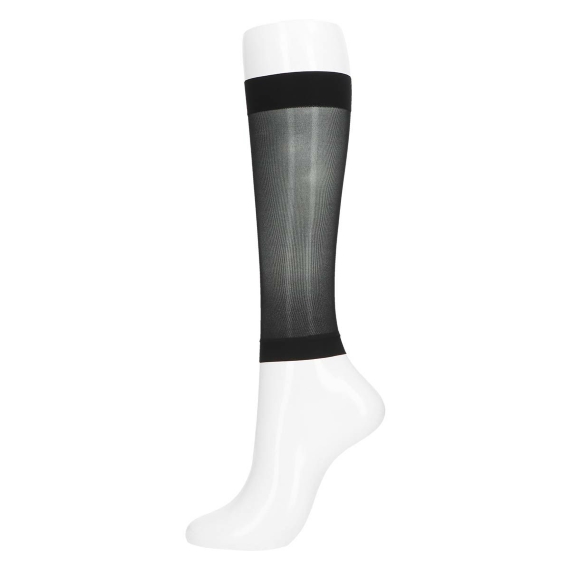
Sock Tube Knitting Process
The sock knitting pattern tube is cylindrical, and the knitting principle is similar to that of the sock leg. During the sock tube knitting process, the transverse dimensions of the sock tube are changed through the needle retracting and unfolding process. Usually, the ankle area needs to be reduced to adapt to the shape of the leg, and the amount of needle reduction is between 0.7 and 0.9 cm. To increase the diversity of the appearance of socks, you can also specify a yarn feeder to knit various patterns and colors on the socks.
Sock Opening Knitting Process
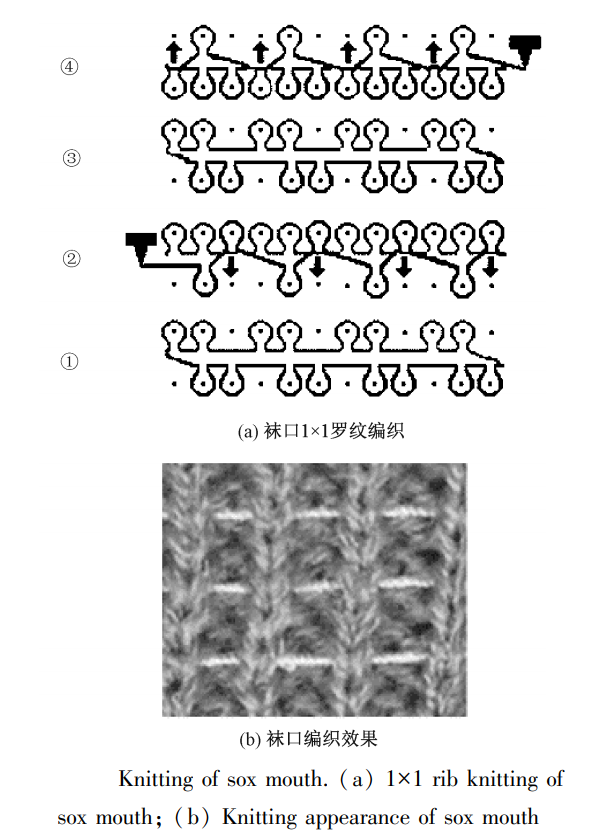
The sock knitting pattern opening structure usually adopts rib knit. A special 1×1 rib knit can be used for cylindrical knitting of the sock opening. The knitting method is shown in the figure. ① represents the initial state of knitting, and the coils on the front and rear needle beds are all one needle forward and one needle back; ② represents the yarn guide knitting the front rib from right to left, and then turning the knitted back stitch from the back needle bed to The front needle bed; ③ represents the state after the needle transfer is completed; ④ represents the yarn guide knitting the back rib from left to right, and then turns the knitting front needle from the front needle bed to the rear needle bed. Through the continuous cycle of knitting processes ①~④ until the sock rib knitting is completed. Compared with the ordinary 1×1 rib knitted using the alternate needle method, the ribs knitted by this knitting method have fewer places to knit with alternate needles, which will not make the ribs extremely shortened, making the sock knitting effect closer to the style of full-needle knitting. Elastic yarn is usually inserted into the sock opening to prevent the socks from slipping when worn. The elastic yarn can be inserted once every 2 rows of knitting, as shown in Figure (b).
When the sock cuff is knitted for final processing, the last part can be knitted in a flat stitching method. There are usually three methods: 1-needle flat stitching, 2-needle flat stitching, and stretchable flat stitching. When knitting with full needles, you will choose a 1-needle flat or a 2-needle flat. When knitting with alternate stitches, choose a flat stitch that will stretch. Stretchable flattening refers to knitting in which drawn yarn is wound around flattening coils, and the yarn feeder that performs flattening must use elastic yarn.
Catalogue Automatic Sock Knitting Machine
The multifunctional yarn creel of LEEFU automatic sock knitting machine is optional equipment, and we suggest the customer buy from the local market and save the container weight and space.
LEEFU automatic sock knitting machine’s standard electric power is single phase and 380V, and we can supply a customized power supply of 220V to meet different customer requirements in the world.
LEEFU automatic sock knitting machine free supply one toolbox per five sets of machines, and the toolbox contain basic machine maintenance tools.
The sock design software has an automatic programming function to automatically generate lower computer control data for sock machine series products. Its functions include pattern design, chain editing, machine parameter setting, data transmission, etc.