


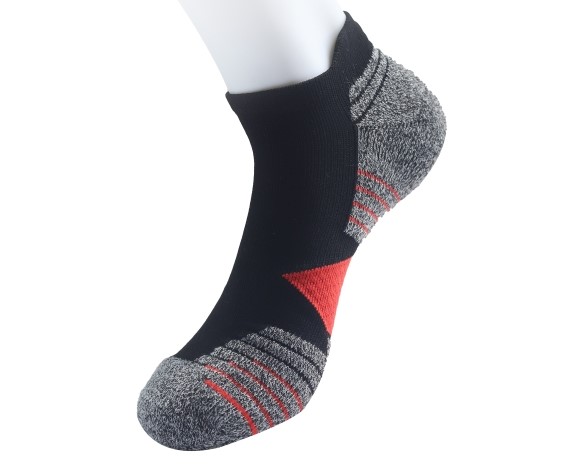
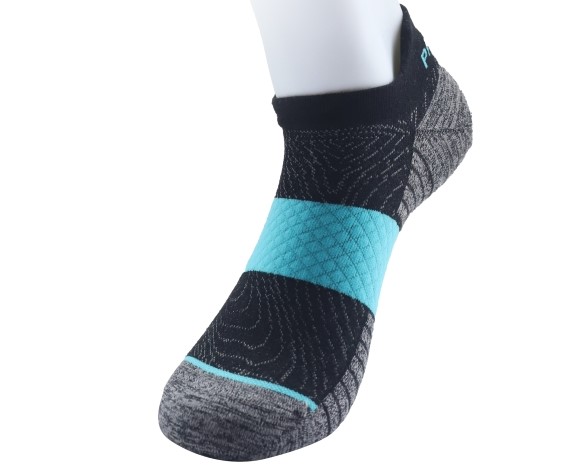
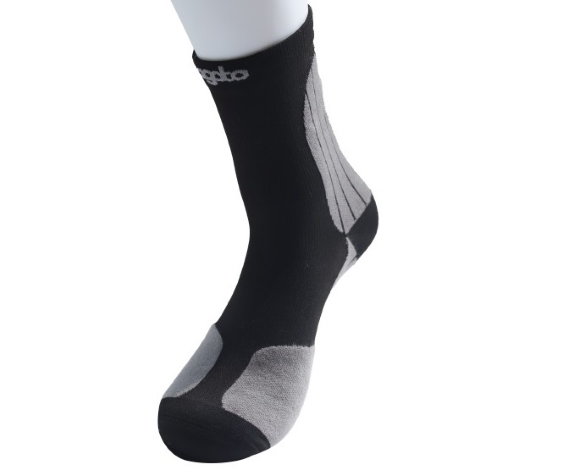
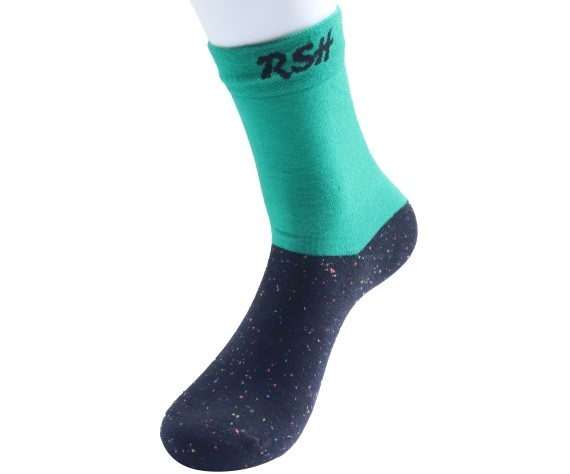
One-time Forming Socks(Automatic Toe-linking Socks)
One-time forming socks is also called one toe sock by automatic toe-linking, and usually consist of a sock opening, a sock tube, a sock heel, a sock foot, and a sock toe. The round sock machine belongs to a category of weft knitting machines. Except for the opening of the sock opening and the formation of the sock toe and heel sections, the knitting principle of the other sections is the same as that of circular weft knitting. The opening and heel (sock toe) parts of the sock opening are formed. The principle is more complex than ordinary circular weft knitting technology.
In the sock forming design, people’s socks knitting needs can be met through changes in organization, density, needle picking, and pressing needles. Different functions can be achieved by changing the needle selection method and the structure, size, and shape of the loops to cause changes in the organization and density of the socks. Hosiery shaping for improved performance or appearance. According to the working principle of the integrated sock knitting machine, the knitting process is divided into four stages: ruffle knitting(rib knitting), sock knitting, sock transferring, and automatic toe-linking. Regarding sock knitting, the working principles of the other three stages will be described below, and the new technology of sock toe closure will be briefly introduced.
Sock Opening Knitting of One Toe Sock
The One Toe Sock openings of single-cylinder socks can be divided into several categories according to their different organizational structures: plain-needle double-layer sock openings, ribbed sock openings, and fake ribs (single-sided tissue uses padding or weft-inserted spandex to form a rib-like effect) sock openings. The ribbed sock opening is first knitted on a small piece-rate rib machine, and then with the help of a set plate, the coils of the ribbed sock opening are manually set on the sock knitting needles of the sock knitting machine needle barrel one by one, and then the sock tube is knitted. The knitting method of padded spandex socks is similar to that of similar structures knitted on a circular knitting machine. The weft-inserted spandex sock opening is based on the ground knitting and is lined with a spandex weft yarn that does not participate in looping. The following introduces the knitting method of flat stitch double-layer socks.
One Toe Sock (Automatic Toe-linking Socks)
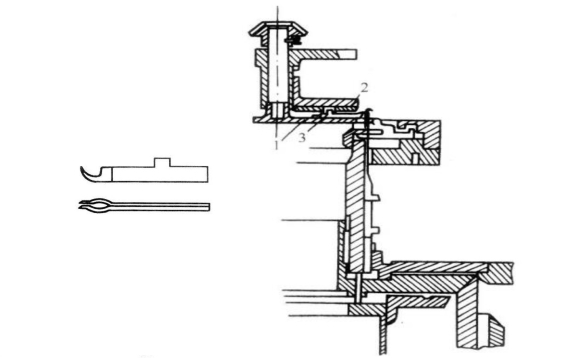
Double Piece Opening And Tying Device Structure of One Toe Sock
No 1 is the tying needle disc, located above the needle cylinder; No 2 is the needle triangle seat; the tying needle No 3 is installed horizontally in the needle groove of the tying needle disc; the tying needle disc 1 is driven by a gear, and it rotates concentrically and synchronously with the needle cylinder.
The tying needle consists of two separate pieces. The heel of the tying needle is divided into long and short, and its configuration is consistent with the sock needle on the needle cylinder, that is, the long heel tying needle is arranged above the long heel sock knitting needles, and the short heel tying needle is arranged above the short heel sock knitting needles. The number of needles is half the number of sock knitting needles, that is, they are inserted above the sock knitting needles one by one. Half of the sock knitting needles in the upper part of the sock are arranged on short heel needles (or long heel needles), and the other half of the sock knitting needles in the bottom part of the sock are arranged on long heel needles (or short heel needles).
The Opening And Tying of Double Piece Tying Needle
Triangles I, J, and K control the radial movement of the tying needle in the puncture needle disc. Triangle K moves the stitching needle out during stitching and hooks up the sock yarn, so it is also called the stitching opening knife. Triangles I and J play a role in stitching and transferring stitches, allowing the loops on the tying needle to be transferred to the sock knitting needles, so it is also called the stitching tying knife.
When knitting plain double-layer socks on a floral sock knitting machine, the needle grooves of the needle cylinder are generally equipped with sock knitting needles, sock bottom needles, and sock jacquard needles from top to bottom. The jacquard needles are used for needle selection. The triangular base of the floral sock knitting machine is shown in the picture. Triangle A acts on the heel of the jacquard needles, causing the sock knitting needle to rise to the unwinding height. The sock knitting needle is pressed down through the upper middle triangle B and inserted into the sock yarn, and then a new loop is formed along the bent yarn triangle C. Triangles F, G, and H are used for opening and tying knitting.
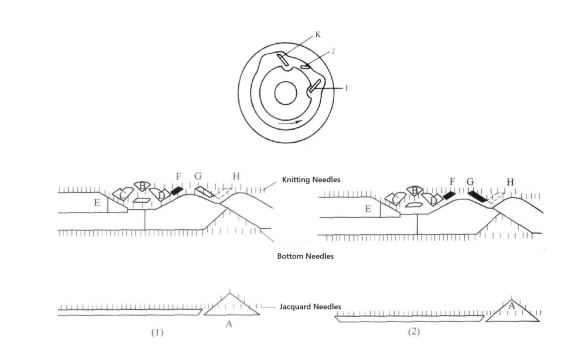
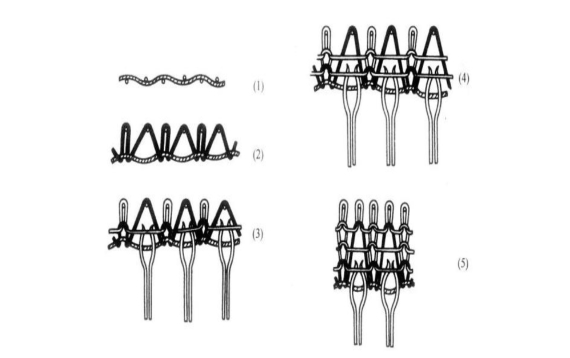
Mouth Opening 1st Process of One Toe Sock
Under the action of triangle F, the lower row of sock knitting needles passes along the bottom of triangle D without sock yarn, and triangles G and H stop working at this time. The Triangle F works in stages. When the short heel needle passes, the triangle F enters the first level, subject to not affecting the short heel, and is ready to act on the long heel needle; when the long heel needle passes (the first half of the needle barrel), Press down the lower row of long heel needles and enter the first level at the same time to act on the short heel needles; when the subsequent short heel needles pass through (the second half of the needle barrel), press down the lower row of short heel needles.
Therefore, in the first revolution of the needle cylinder, only the raised sock knitting needles in the upper row are padded with sock yarn. When these sock knitting needles pass through panel E, the sinkers move forward, pushing the sock yarn on the pad toward the needle cylinder. In the center direction, the sock yarn is behind the unraised sock knitting needles, forming a spaced yarn pad.
Mouth Opening 2nd Process of One Toe Sock
When knitting the second row of one toe sock, the sock yarn guide lays yarn on all sock knitting needles. For this purpose, triangle G must enter the first level before the long heel needle passes, so that in the first half of the second revolution of the cylinder (when the long heel needle passes), triangle G acts on the long heel needles at the lower position, causing them to rise, participate in the sock yarn laying and looping, as shown in Figure 2. At this time, triangle F exits the first level.
In the second half of the second revolution of the needle cylinder (when the short heel needles pass through), triangles F and G do not work on the short heel needles, because these two triangles are in the middle position, so the lower row of short heel sock knitting needles is ascending with triangle D. In this way, all the sock knitting needles hook the sock yarn under the action of triangles B and C, so that normal loops are formed on the sock knitting needles that were raised in the previous row (odd-numbered needles), while only unclosed hanging arcs are formed on those sock knitting needles that are not raised.
Mouth Opening 3rd Process of One Toe Sock
When knitting the third row of one toe sock, the sock knitting needles are still rising one by one. To do this, triangle G must exit one level before the long heel needle passes, so that the long heel needle is divided into two rows, upper and lower, while triangle F is still in the middle position. When the long heel needle passes, triangle F enters one level again, and then presses down the lower row of short heel needles, so that the sock knitting needles are knitted one by one.
On the third revolution of the syringe, the needle begins to work. At this time, the triangle K in the triangular base of the mouth needle drops one level before the long heel needle passes. When the long heel needle passes, the triangle K drops one level again. Therefore, all the tying needles are extended out of the disk by the action of the triangle K, and are extended into the gap of every other needle to hook the sock yarn, as shown in Figure 3. The triangle K stops working at the end of the third rotation of the needle cylinder, that is, when the long heel needle is rotated to the triangle K again, it stops working. After the stitching needle hooks the sock yarn in the third row, return along the edge of the triangular ring, and hold these loops until the sock opening is knitted.
Mouth Opening 4th Process of One Toe Sock
When knitting in the fourth row of one toe sock, the needles on the needle cylinder are still knitted one by one, as shown in Figure 4.
The fifth row and subsequent rows are looped on all sock knitting needles, as shown in Figure 5. Therefore, before knitting starts in the fifth row, that is, when the short heel needles pass through triangle G, triangle G enters the first level. When the long heel needles pass through triangle G, triangle G lifts up the lower row of long heel needles so that they are in the knitting position. The top of triangle D is passed. Later, when the short heel needle passes, triangles F and G stop working, and all the long heel needles and short heel needles are padded into loops to form a flat sock opening of the required length.
The 1st Process of Tying Sock Mouth
Concept: After knitting the one toe sock opening to a certain length, transfer the loop on the stitching needle to the sock needle hook, and fold the length of the knitted sock opening into double layers. This process is called stitching.
When tying and transferring loops, triangles I and J in the cam of the tying needle and triangles H and G in the cam of the sock needle work simultaneously. Due to the action of the jacquard needles, the sock knitting needles rise one by one. Before the long heel needle passes, the triangles H and G enter the first level and are in the middle position. When the long heel needle passes, triangle H enters the first level again, and triangle G still stays in the middle position. Under the action of triangle H, the sock needle that has not been raised is dropped to a lower position. At this time, the needle is located on the same level as the nose of the sinker, making it possible for the needle with the coil to extend outward.
The 2nd Process of Tying Sock Mouth
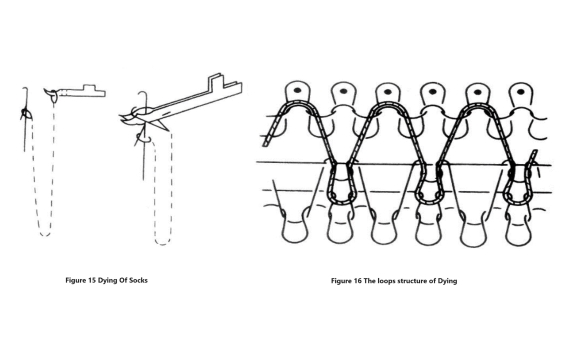
At the same time, when the short heel needle passes through, triangles I and J drop one level, and when the long heel needle passes, they decrease again. Triangle I moves the tying needle out, so that the small round hole of the tying needle is above the needle head which is lowered by triangle H. Afterwards, the sock needle rises along the right slope of the right panel, so that the needle penetrates into the small hole of the tying needle, as shown in Figure 15. Triangle J holds the needle back, thus transferring the loop on the needle to the sock needle. After that, all sock knitting needles rise along triangle D and enter the knitting area. At this time, on every other sock needle, in addition to the original old coil, there is also a coil transferred from the sock knitting needle. In the subsequent knitting process, the two coils are taken off together on the new loop, and the sock cuff is folded in half and connected. The loop structure at the sock tying cuff is shown in Figure 16.
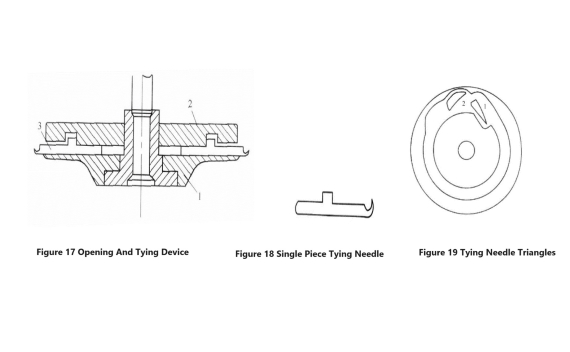
Single Piece Opening And Tying Device Structure of One Toe Sock
High-end sock machines use single piece tying needle opening and tying devices, as shown in Figure 17. No 1 is the tying needle plate, No 2 is the tying needle triangle seat, and No 3 is the single piece tying needle. Its shape is shown in Figure 18. There is a hook at the front end, which is used to hook the sock yarn and collect the loop. There is a heel on each piece of heel needle, and it is divided into long and short heel. The arrangement method of long and short heel needles is to arrange long heel needles above the long heel needle, but the number of long heel needles can be less than that of the tying needle. Half of the total number of needles depends on the time required for the tying needle triangle to move in and out of the working position. The needles are arranged at intervals just above the sock knitting needles. Figure 19 shows the triangular configuration in the triangular base of the tying needle. Triangles 1 and 2 control the radial movement of the tying needle in the groove, but they only enter work when opening and tying the mouth.
Mouth Opening Process of One Toe Sock For Single Piece
When knitting the first row of One Toe Sock, the sock knitting needles rise one by one and are inserted into the starting line I. Due to the action of the sinker, the sock yarn on the mat is pushed to the center of the needle cylinder, so that the sock yarn is behind the sock knitting needles that have not been raised, forming a spaced yarn pad, as shown in Figure 1.
When knitting the second row of One Toe Sock, all sock knitting needles rise and insert sock yarn II, as shown in Figure 2.
When knitting the third row of One Toe Sock, use the jacquard needle to select needles every other three, that is, the 1st, 5th, 9th… sock needles rise to eat sock yarn III, while the other sock knitting needles do not rise. At this time, the tying needle is in triangle 1, stretch out the tie plate and put a long floating wire on it, as shown in Figure 3. Triangle 1 graded entry into work.
When knitting the fourth row of One Toe Sock, all sock knitting needles rise to take up sock yarn IV, and knit plain stitches until the required sock opening length is formed, as shown in Figure 4.


Tying Process of One Toe Sock For Single Piece
After the sock opening is knitted to the specified length, the cams 1 and 2 of the tying needle enter the working position in stages, so that the tying needle extends out of the disc again. At the same time, the sock knitting needle uses the jacquard needle to select needles one by one, that is, the 1st, 3, 5… The sock knitting needle rises. At this time, under the action of triangles 1 and 2, the tying needle stretches out and then retracts immediately. Put the long floating thread held when opening the sock into a three-part sock. on the needle, because only the 3rd, 7th, 11… sock knitting needles can obtain the floating thread held between the two tying needles, and there is no floating thread above the other odd-numbered needles, thus forming a gap of three. After stitching and transferring the stitches, all the sock knitting needles will enter the knitting area and take up the sock yarn to form a loop, forming a double-layer sock top.